-
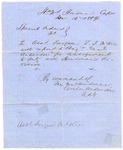
Military order, issued and signed by Thomas Hindman. January 14, 1864
Thomas Carmichael Hindman
Military order issuing Sargent T.J. McKie to report to Brig. Genl. Anderson to be assigned a position within Hindman's divison. Issued and signed by Thomas Hindman. Endorsements on docket, recto, by Manigault and Barth. January 14,1864.
-
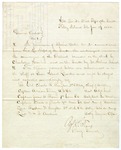
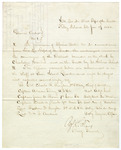
General A.H. Terry Assumes Command and Names his Staff, Folly Island, SC, 1864
Alfred H. Terry
Terry, U.S Army, assumes command of the north district of the Department of the South at Folly Island, S.C., near Charleston and names his headquarters staff.
-
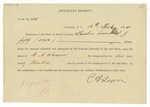
Receipt to C. Sareon for loss of his slave, Hooker, to employment in the Confederate Army, South Carolina. Columbia, February, 1864.
South Carolina
Instrument indicating Sareon received $1250 from S.C. for having Hooker, his slave, build military fortifications in the state.
-
Substitute soldier certificate for Phillip Siebert
New York County (N.Y.) and Phillip Siebert
Phillip Siebert is mustered as a substitute soldier in the United States Army in return for $300.
-
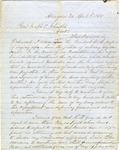
Copy of a letter from John Hunt Morgan to Confederate General Joseph E. Johnston regarding the former's arrival in Richmond and interview with Confederate President Jefferson Davis.
John Hunt Morgan
Confederate General John H. Morgan writes to General Joseph E. Johnston to relate Morgan's conversation with Jefferson Davis, in which he requested restoration of his command. Morgan also mentions the possible expedition intended against Nashville. He informs Johnson of information, from an officer who had escaped from the Nashville Penitentiary, that claimed there would be no difficulty in accomplishing all intended in Nashville as there were no more than three hundred troops, "most of whom were negroes," dated April 3, 1864.
-
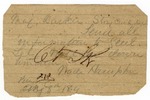
Wade Hampton battlefield note
Wade Hampton
A small (12x8cm) battlefield note. Wade Hampton was a Confederate General from South Carolina. In 1876 he became governor of that state.
-
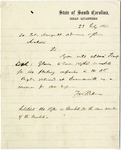
Francis Pickens letter to Col. Manigault allowing Lieut. Col. Glover to acquire to 160 rifled muskets for defense. Summerville, South Carolina. July 23, 1864.
Francis Wilkinson Pickens
F.W. Pickens orders that Colonel Manigault at Charleston allow Lieutenant Colonel Glover to have 160 rifled muskets for his reserve 1st Regiment in Summerville, South Carolina. Signed by F.W. Pickens, July 23, 1864.
-
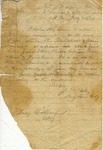
John H. Kelly letter to Major E.S. Barford, dated July 28, 1864.
John Herbert Kelly
Confederate brigadier general John H. Kelly writes a letter at 1 a.m., describing his slow progress and intentions to "strike the Flat Shoals and Jonesboro war." Dated July 28, 1864, at "McDonega & Atlanta Road."
-
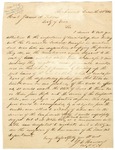
Letter from James Harrison to James A. Seddon, December 23, 1864.
James Harrison
Harrison, colonel in the Confederate Army, suggests to the Confederate Secretary of War James Seddon the establishment of an alliance with Comanche Native Americans to disrupt United States trade and government routes in the West.
-
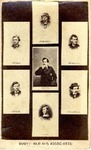
Carte-de-visite composite image: "Booth and his Associates," no date.
Anonymous
Composite carte-de-visite featuring the likenesses of John Wilkes Booth and the six men convicted of conspiring with him to assassinate President Abraham Lincoln and William Seward. No date.
-
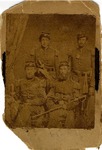
Photograph, four unidentified United States officers in group portrait photograph by W.P. Egbert, Davenport, Iowa, no date.
W. P. Egbert
Four United States/Union/Federal officers pose in a group portrait photograph; two are seated, two stand. Each holds a sword. No subjects are identified but the verso of the photocard identifies W.P. Egbert, "Ambrotype and Photograph Artist," of Davenport, Iowa, as the creator. Creation date presumably American Civil War era, 1861-1865.
-
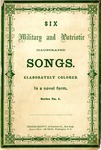
Six Military and Patriotic Illustrated Songs. Elaborately Colored. In a novel form. Series No. 1.
Charles Magnus, John F. Poole, W. J. Florence, George P. Holt, Daniel Decatur Emmett, Tony Pastor, and Dan Bryant
This publication contains the lyrics to six songs, each accompanied by a color illustration, and an advertisement on the last page.
1. Our Grandfathers' Days
2. The Captain with his Whiskers
3. Want — A Substitute
4. Dixie's Land
5. Young American and ould Ireland
6. Kingdom Coming
-
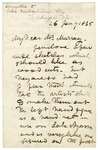
Letter from David Livingstone to John Murray regarding ideas for woodcuts, January 26, 1865.
David Livingstone
Livingstone refers to enclosures not included in this item that are apparently sketches "I should like as woodcuts."
-
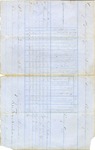
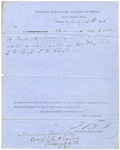
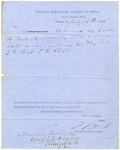
Report of effective strength of cavalry brigade signed by Robert H. Anderson, Lawtonville, S.C., January 30, 1865.
Robert H. Anderson
Form signed by Confederate General Robert H. Anderson indicating his cavalry unit had an effective strength of over 1000 men.
-
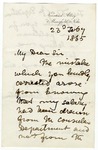
Letter from David Livingstone to Austin Layard, February 23, 1865.
David Livingstone
Livingstone writes to Layard regarding a "mistake" about the source Livingstone's salary.
-
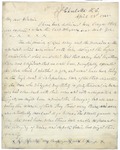
Letter from Joseph E. Johnston to Winnie
Joseph Eggleston Johnston
Letter from Joseph E. Johnston to Winnie, written at Charlotte, N.C. on April 23, 1865, less than two weeks after General Lee's surrender at Appomattox and the assassination of Abraham Lincoln. Johnston discusses the state of his forces and the Confederacy.
-
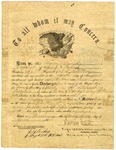
Discharge of Myron Kennedy
U.S. Government
Myron Kennedy, 19, of New York, is discharged from the United States Army in June 1865 after almost 3 years of service.
-
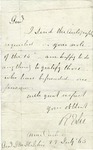
A letter from Robert E. Lee containing his autograph for General J.M. St. John. Cartersville, Virginia, July 25, 1865.
Robert Edward Lee
A letter from Robert E. Lee to General J.M. St. John containing his autograph for the gratification of those who befriended their prisoners. Written near Cartersville, Virginia; dated July 22nd, 1865.
-
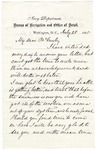
Percival Drayton letter to Ely McCauley, July 28, 1865, Washington, D.C.
Percival Drayton
Drayton writes he is glad to hear that McCauley's health is improving and invites him to Washington, D.C. if he has time to visit. At the time of writing, McCauley was a Lieutenant Commander in the Navy and Drayton was head of the Bureau of Navigation and Office of Detail within the Navy; this letter is written on the bureau's stationary.
-
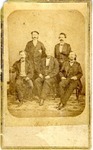
Carte de visite, Confederate Generals Sterling Price, John Magruder, William Hardeman, Henry Allen, and Thomas C. Hindman in Mexico, in civilian dress, ca. 1866; print from negative by Matthew Brady.
Matthew B. Brady
These Confederate Generals left the United States for Mexico at the close of the Civil War. Standing in the rear (left to right) are John Bankhead Magruder and William P. Hardeman. Seated (left to right) are Henry W. Allen, Sterling Price, and Thomas C. Hindman. Verso indicates original negative by Matthew Brady. Verso annotations do not appear to be completely correct in identification of subjects.
-
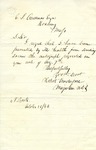
U.S. Army General Robert Anderson letter in which he provides his autograph, Roxbury, Mass., October 28, 1866.
Robert Anderson
Anderson apologizes for his delayed response to the request for his autograph.
Broadus R. Littlejohn, Jr. (1925 - 2010), Spartanburg native, businessman, and philanthropist, collected the manuscripts shown here. These manuscripts are a portion of Mr. Littlejohn's personal collection, which also includes archival collections, ephemera, textiles, and objects. The collection has been housed in the Wofford College library since 2007, and and in 2011 the library accepted the generous donation of the whole of Mr. Littlejohn's collection.
Printing is not supported at the primary Gallery Thumbnail page. Please first navigate to a specific Image before printing.